

How did you learn to ride a bike? What is your history with bicycling?
I learned by being let go down a hill by one of my cousins. I was between five and ten. I grew up in many places; Europe and in Washington DC, but I would spend summertime with relatives in Southeastern Connecticut, right on the water, and that's where I learned to bike. I recall smashing into a mailbox when I didn’t have a proper light when I was a teenager.
I went to Pomona College in California, and I had to have a bike to get around the big footprint of the Claremont Colleges. I lived off-campus and biked to and fro. After college, I always had a bike, but after grad school I moved to New York City and I never for a second thought of biking there, because not very many people biked in Manhattan in the mid-eighties. Once my husband and I moved down to Philadelphia in 1993, he bought me a bike and it seemed a lot more doable to bike around. Gradually I got used to riding in traffic, which was not where I was accustomed to riding before. But I didn't really consider myself a bicyclist; to me, bicyclists were either messengers or were people who did road cycling on weekends, and I was neither. Not that there was anything wrong with that, but for me, riding a bike was utilitarian. I was more interested in riding around to run errands and get back and forth between places, because I'm chronically behind schedule, and walking takes too long. Philadelphia is so easy to bike in.
Can you tell me how you got involved in the Schuylkill campaign? It was an epic fight that just concluded now with the building of the bridge.
Yes, the connector bridge opened in October 2012. When we moved to Philly in 1993 and bought our house in the Logan Square neighborhood, we were told by our realtor that a park would be built down by the Schuylkill River, a few blocks away. Until the park was built in 2003, I crossed over the tracks with my dog and my babies on my back and walked around the scrubby and unlandscaped riverfront. I got interested in the issue when construction finally began because it was clear that no one had a good answer of how we were going to be able to get into the park once it was built. The first thing that was done on the construction site was the installation of a fence. A group of us who were neighbors in the Logan Square neighborhood started meeting and getting to know people in the Fitler Square neighborhood, and together we went to meet with the Streets Department, the Law department and the Schuylkill River Development Corporation to find out how to keep the crossings open at Race and Locust Streets. It was clear that we were going to have to take this on, because CSX was not interested in permitting pedestrian crossings over its freight lines.
We knew we had to wage a citizen action campaign, so we formed a campaign called Free Schuylkill River Park. This was 2004, and we created a blog, and my husband was able to set us up with a fairly new thing called an e-mail action service. We started to link from the blog to where you could send an e-mail, and we put the e-mail address for the head of CSX, the Mayor, City Council, anyone who we needed to convince to keep the crossings open. We also created an online petition and went down to the path to ask people to sign the petition. That helped us build up an email list.
It took two years but the City and CSX finally came to an agreement, which was that CSX would allow the two “at grade” crossings to remain open with gates and fencing, and the city would build a bridge in the vicinity of Locust Street to provide an “above grade” crossing. That was signed in 2007, and it took till 2012 to get the two crossings and bridge all done.
 It must have been a pretty great day when that bridge opened!
It was a great day. I was very gratified, and pretty humbled too. It's awesome to have been part of making such an appealing piece of infrastructure possible.
I want to talk about Women Bike PHL, and how it fits into the greater narrative of bicycling advocacy. How does the advocacy that you do tie into making cycling more attractive to women?
I work both on getting trails connected and building out the trail network, The Circuit, and I also work on building the city's bike network. I think the more the city and region builds longer, connected, on-road and off-road networks that make people, especially women, feel safe, the more both men and women will want to use them. The safer the roads and trails appear to be, the more women will want to bike on them.
Can you tell me how you got involved in the Schuylkill campaign? It was an epic fight that just concluded now with the building of the bridge.
Yes, the connector bridge opened in October 2012. When we moved to Philly in 1993 and bought our house in the Logan Square neighborhood, we were told by our realtor that a park would be built down by the Schuylkill River, a few blocks away. Until the park was built in 2003, I crossed over the tracks with my dog and my babies on my back and walked around the scrubby and unlandscaped riverfront. I got interested in the issue when construction finally began because it was clear that no one had a good answer of how we were going to be able to get into the park once it was built. The first thing that was done on the construction site was the installation of a fence. A group of us who were neighbors in the Logan Square neighborhood started meeting and getting to know people in the Fitler Square neighborhood, and together we went to meet with the Streets Department, the Law department and the Schuylkill River Development Corporation to find out how to keep the crossings open at Race and Locust Streets. It was clear that we were going to have to take this on, because CSX was not interested in permitting pedestrian crossings over its freight lines.
We knew we had to wage a citizen action campaign, so we formed a campaign called Free Schuylkill River Park. This was 2004, and we created a blog, and my husband was able to set us up with a fairly new thing called an e-mail action service. We started to link from the blog to where you could send an e-mail, and we put the e-mail address for the head of CSX, the Mayor, City Council, anyone who we needed to convince to keep the crossings open. We also created an online petition and went down to the path to ask people to sign the petition. That helped us build up an email list.
It took two years but the City and CSX finally came to an agreement, which was that CSX would allow the two “at grade” crossings to remain open with gates and fencing, and the city would build a bridge in the vicinity of Locust Street to provide an “above grade” crossing. That was signed in 2007, and it took till 2012 to get the two crossings and bridge all done.

It was a great day. I was very gratified, and pretty humbled too. It's awesome to have been part of making such an appealing piece of infrastructure possible.
I want to talk about Women Bike PHL, and how it fits into the greater narrative of bicycling advocacy. How does the advocacy that you do tie into making cycling more attractive to women?
I work both on getting trails connected and building out the trail network, The Circuit, and I also work on building the city's bike network. I think the more the city and region builds longer, connected, on-road and off-road networks that make people, especially women, feel safe, the more both men and women will want to use them. The safer the roads and trails appear to be, the more women will want to bike on them.


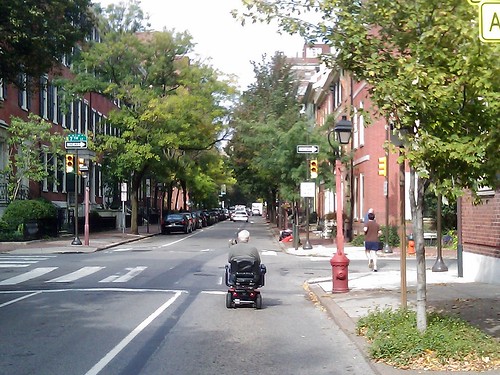
.JPG) Steve Buckley from the Mayor's Office of Transportation gave the presentation and fielded the audience's questions (and comments), of which there were many. Some Society Hill residents did express concern and fear about the impact of the bike lanes on their neighborhood.
Steve Buckley from the Mayor's Office of Transportation gave the presentation and fielded the audience's questions (and comments), of which there were many. Some Society Hill residents did express concern and fear about the impact of the bike lanes on their neighborhood. .JPG)